- Home
- Corporate
- Editorials
- Density vs. Clarity: The Core Tension in Modern UI Design
Density vs. Clarity: The Core Tension in Modern UI Design

Every generation of designers seems to rediscover the same paradox: the more information we display, the less anyone can process. The web is overflowing with pixels competing for attention; yet clarity the ability for a user to simply understand what’s happening is scarcer than ever. Somewhere between Apple’s whitespace-heavy interfaces and Bloomberg Terminal’s data deluge lies the unresolvable tension of modern UI design: density vs. clarity.
The pendulum of design taste
If you’ve been designing interfaces for more than five years, you’ve watched the pendulum swing. Around 2010, the industry was obsessed with minimalism “clean” meant “good”, and whitespace became a moral value.
Flat design, ghost buttons, and monochrome iconography became shorthand for modernity. Then came the backlash: designers and users alike realized that minimalism had stripped interfaces of cues, affordances, and even warmth.
Today, the pendulum is swinging back toward density. Productivity apps like Notion, Linear, and Figma aren’t afraid to show you a lot. Dashboards, complex filters, and nested hierarchies are back in fashion. The question isn’t which direction is “right” it’s how to balance the competing truths of cognitive load and visual economy.
The illusion of clarity
Clarity is not just fewer elements. Over-minimalism often reduces clarity. When designers strip away what feels redundant, they also remove what guides comprehension: context, hierarchy, and expectation.
A sparse interface may look calm, but the user’s mind can still be frantic wondering what to click, what’s safe, what’s next.
Clarity comes from meaningful structure, not emptiness. A dense design can be clear if relationships are visually encoded through contrast, grouping, or rhythm. That’s why Google Maps, despite being absurdly dense, still feels navigable: it uses motion, layering, and color to manage chaos. Clarity isn’t about less; it’s about organization.
Density as a virtue
Let’s be honest users aren’t browsing art galleries. They’re managing projects, tracking metrics, editing video timelines. Dense UIs exist because density is efficient. There’s a reason professionals still love tools like Excel or AutoCAD: when you know what you’re doing, density accelerates cognition. You don’t want to click through seven screens to find a setting; you want it right there.
The problem isn’t density itself it’s uncurated density. It’s when everything screams at the same volume.
Modern design systems often oversimplify this tension by equating “clarity” with “emptiness.” The best UIs (think Figma’s layer panel or Photoshop’s toolbar) let density breathe through subtle grouping, alignment, and rhythm.
The tyranny of the fold
Density feels rebellious because we’ve been conditioned to fear scrolling and folds. Marketing sites taught us to optimize for single screens, but products aren’t ads. In workspace tools, scrolling is navigation not failure.
Designers still conflate vertical space with user burden, compressing everything into compact panels, dropdowns, or hover states. Ironically, this “efficiency” often backfires: the UI becomes cognitively dense yet visually flat, like an overpacked suitcase of socks and wires.
A better lens: clarity of interaction, not just clarity of appearance.
The Figma paradox
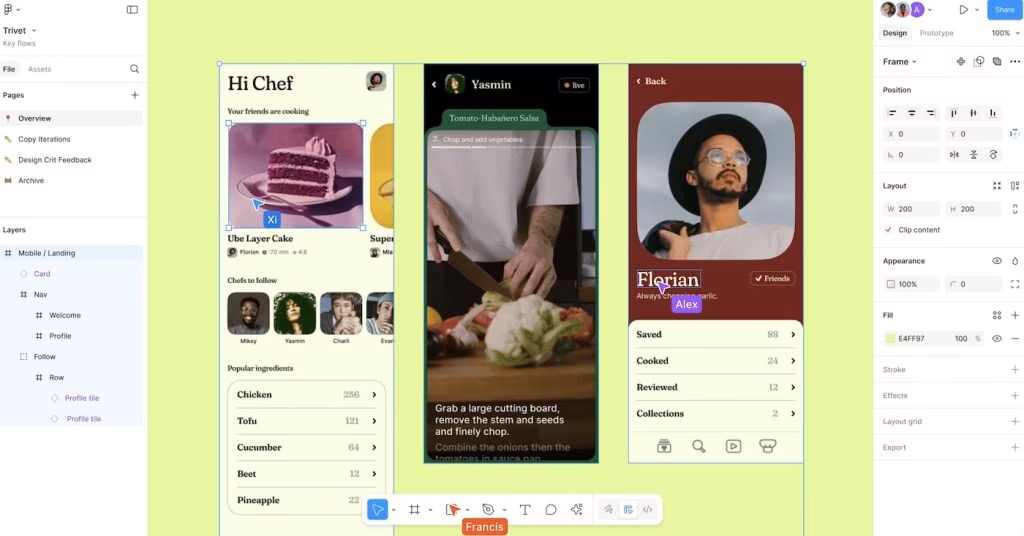
Figma is a fascinating case study. It’s arguably one of the densest design tools ever created, yet most people find it pleasant. Why? Because Figma handles density like a jazz musician handles complexity: structured improvisation.
Panels collapse and expand predictably, focus shifts with intent, and hierarchy is visually obvious. It doesn’t pretend to be simple it embraces complexity while keeping it legible. Compare that to modern “clean” SaaS dashboards that hide everything under icons or hamburger menus. You click endlessly just to reveal what used to be obvious. That’s not clarity; that’s concealment.
The aesthetic of effort
Another cultural force driving this debate is the aesthetic of effortlessness. Designers are told their work should look invisible—“it just works.” But true clarity often reveals its structure.
Information-dense interfaces may look intimidating at first, but that’s because they’re honest. They expose the architecture of the tool, the way a cockpit exposes flight systems. A clean, minimalist UI may feel soothing, but it can infantilize the user—pretending everything is simple when it isn’t.
Designing for literacy, not laziness
The uncomfortable truth is this: clarity scales with literacy. A dense interface is unreadable to a novice, but liberating to an expert. We can’t design every product as if the user has never seen a computer before. There’s a difference between bad usability and expert tooling.
A future-facing design philosophy would recognize this: clarity and density are relative. Instead of flattening everything into one-size-fits-all simplicity, we should design adaptive systems that grow with user expertise progressive disclosure done right.
Where this leaves us
We are living in a post-minimalist era, where purity of form has given way to pragmatic chaos. Clarity is no longer achieved through subtraction it’s achieved through orchestration. Interfaces now carry more responsibility: dashboards for data, creativity, communication, and AI co-pilots. The challenge isn’t to make them “simple.” The challenge is to make them legible.
Perhaps the tension between density and clarity isn’t something to fix. Perhaps it’s the design equivalent of musical tension the dissonance that makes the piece alive.
Our job as designers isn’t to silence one side. It’s to make the tension sing.